What is pickleball? Rules, court and equipment explained
Court, kitchen, serve, scoring and equipment: everything you need to know before your first game.
Pickleball combines elements of tennis, badminton and table tennis. It is played with solid paddles and a perforated plastic ball on a small court. The rules are quick to learn and most beginners enjoy real rallies within their first hour. Yet there is plenty of tactics in the game. That mix is what makes pickleball so appealing to newcomers and former tennis or table tennis players alike.
Where does pickleball come from?
The game was invented in 1965 on Bainbridge Island in Washington State, USA. Joel Pritchard, Bill Bell and Barney McCallum were looking for something to keep their families busy on a summer day and improvised with a badminton court, wooden paddles and a perforated ball. Where the name comes from is still debated: one story points to the "pickle boat" in rowing, another to the family dog, Pickles.
In the USA, pickleball has been described as the fastest-growing sport for several years. Across Europe, more and more clubs, court times and tournaments are appearing.
The court
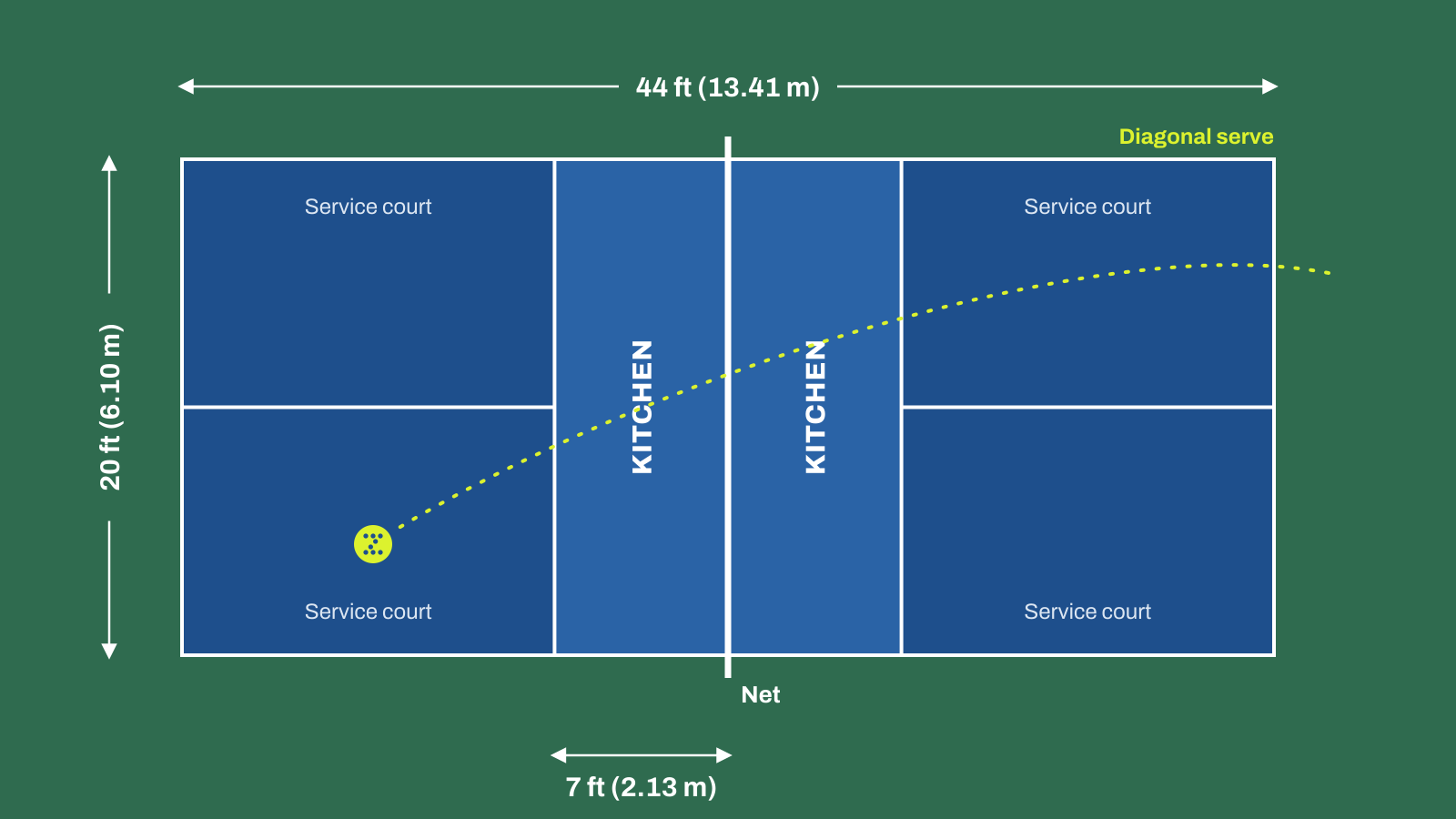
A pickleball court is 44 feet long and 20 feet wide (13.41 × 6.10 m), the same size as a badminton doubles court. Singles and doubles are played on the same court. The net is 36 inches high at the sidelines and 34 inches in the middle.
Each half of the court has two areas:
- The kitchen (officially the non-volley zone): the 7-foot zone right next to the net
- Two service courts: left and right behind the kitchen, divided by the centreline
The kitchen
The kitchen is pickleball's most distinctive feature. You may not hit the ball out of the air (volley) while standing in it. The kitchen line counts as part of the kitchen, so standing on it while volleying is a fault. Your momentum after a volley must not carry you into the kitchen either.
Once the ball has bounced in the kitchen, you can step in and play it. This leads to the typical "dinks": short, soft shots that drop just over the net into the opponents' kitchen. Whoever loses patience in these exchanges usually loses the point.
The serve
- Serve from behind the baseline, diagonally into the opposite service court.
- The classic serve is hit underhand: the ball is struck below waist level.
- The drop serve is also allowed: drop the ball and hit it after it bounces.
- The serve must not land in the kitchen. A serve that touches the kitchen line is also a fault.
- You only get one attempt per serve.
The two-bounce rule
After the serve, the ball must bounce once on each side before anyone may volley. The receiving team has to let the serve bounce, and the serving team has to let the return bounce. Only then can the ball be played out of the air.
This rule takes away the server's advantage and leads to longer rallies. The third shot of a rally is therefore often a "third shot drop": a soft ball into the opponents' kitchen that gives the serving team time to move up to the net.
Scoring
With traditional scoring, only the serving team can win points. Games are usually played to 11, and you must win by two. Tournaments also use games to 15 or 21. Some professional formats now use rally scoring, where every rally wins a point.
In doubles, both partners serve before the serve passes to the other team. Before each serve, the server calls three numbers:
- their own team's score
- the opponents' score
- whether they are the first or second server
At the start of a game, only one player of the first serving team gets to serve. That is why every doubles game starts with the call "0 – 0 – 2".
Common faults
A rally ends when
- the ball lands out,
- the ball goes into the net,
- the ball bounces twice on one side,
- a player volleys from inside the kitchen, or
- the two-bounce rule is broken.
Equipment
- Paddle: Pickleball paddles are larger than table tennis bats and smaller than padel rackets. Most have a polymer honeycomb core and a fibreglass or carbon face. A solid all-round model is all you need to start.
- Ball: Outdoor balls are harder and usually have around 40 smaller holes. Indoor balls are softer, lighter and usually have around 26 larger holes. Tournaments only allow officially approved balls.
- Shoes: Indoor court shoes with non-marking soles inside, tennis shoes outside. Running shoes give too little support for all the sideways movement.
Frequently asked questions
Is pickleball hard to learn?
No. The basic rules can be explained in a few minutes, and thanks to the slow ball and small court, even beginners quickly get into rallies. The game becomes demanding as you improve: then patience, placement and team tactics decide.
What is the difference between pickleball and padel?
Padel is played on a larger court enclosed by walls, and the walls are part of the game. Pickleball has no walls, a smaller court, a perforated plastic ball and the kitchen at the net. Both use a solid paddle without strings.
Can you play pickleball on a tennis court?
On hard courts, yes. Pickleball courts can be marked on them with tape or lines, and portable nets make setup easy. Many clubs use their existing courts for both sports this way.
Important: You cannot play pickleball on clay courts, which are the most common type in some European countries. The light perforated ball barely bounces on clay, and when it does, unpredictably. Pickleball needs a firm, even surface such as a hard court, an acrylic or synthetic surface, or an indoor floor.
Where can I try pickleball?
Many cities have clubs and venues that offer taster sessions. PickleZone will soon help you find coaches and courts near you.