Elongated, Widebody or Hybrid? Which Pickleball Paddle Is Right for Me?
More reach or more forgiveness? What sets the three paddle shapes apart, why the handle matters too and which shape suits your game.
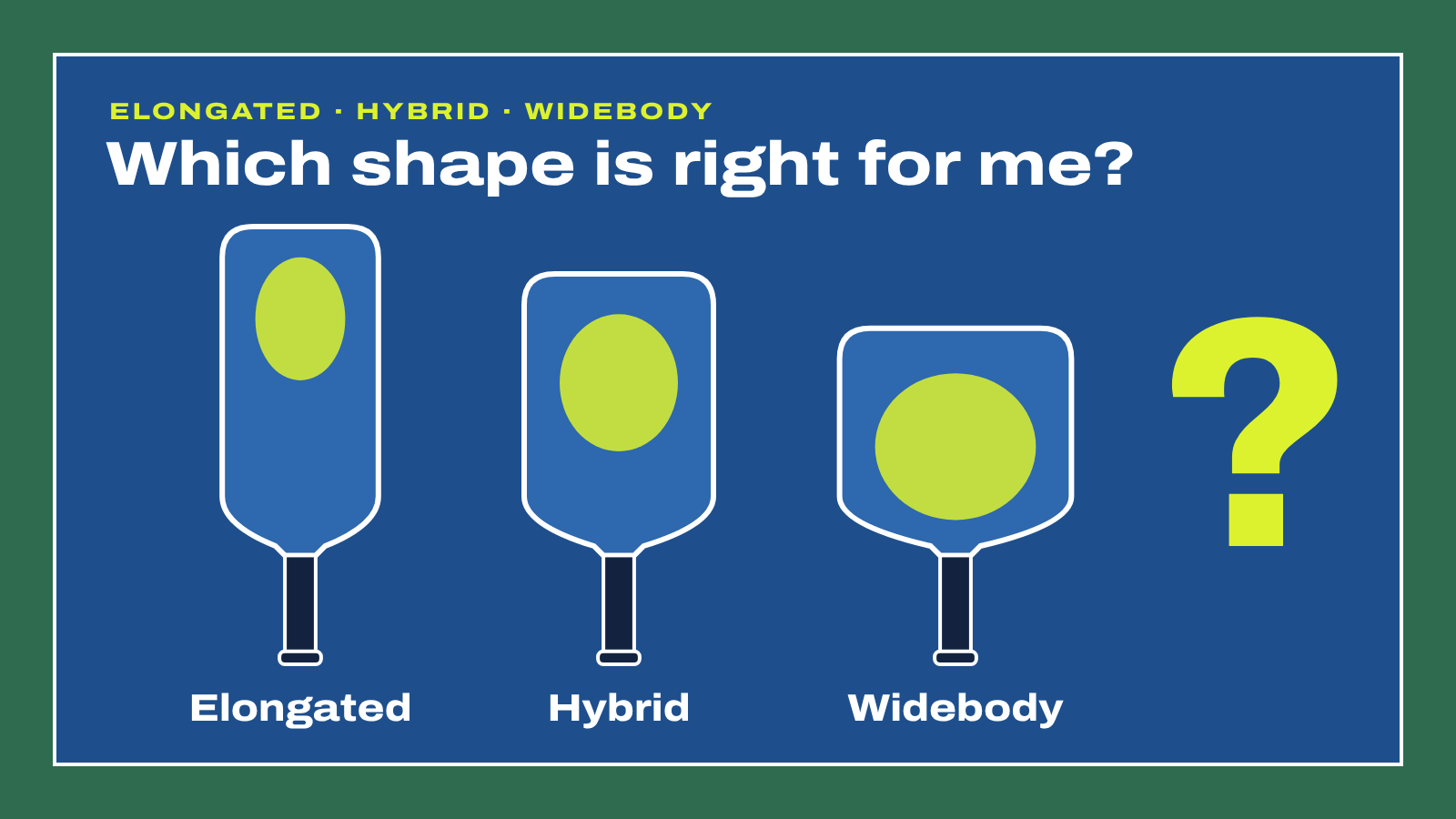
If you are looking for a new paddle, you will quickly come across three terms: elongated, hybrid and widebody. They describe the shape of the paddle. Shape helps decide how much reach you have, how forgiving the paddle is on off-centre hits and how quick your hands are at the net. Here you will learn how the three shapes differ and which one suits your game.
Why there are different shapes at all
The rules set the framework: the combined length and width of a paddle may not exceed 24 inches (60.96 cm), including edge guard and butt cap. The length alone may not exceed 17 inches (43.18 cm). There are no limits on weight or thickness.
In other words: if a paddle is made longer, it has to be narrower – and vice versa. Every shape is a compromise between reach and surface area.
The three shapes at a glance
| Shape | Typical size | Reach | Sweet spot | Hands at the net | Share* |
|---|---|---|---|---|---|
| Elongated | 16.5 × 7.5 in (41.9 × 19.1 cm) | most | narrowest, higher up | slowest | 41 % |
| Hybrid | 16.25 × 7.75 in (41.3 × 19.7 cm) | medium | medium | balanced | 42 % |
| Widebody | 16 × 8 in (40.6 × 20.3 cm) | least | largest, centred | fastest | 17 % |
*Share: main paddle of around 1,700 active players, analysed by Pickleball Effect.
The cover image above is deliberately exaggerated. In reality the differences are small – often just a quarter or half an inch. At the net, you still feel them clearly.
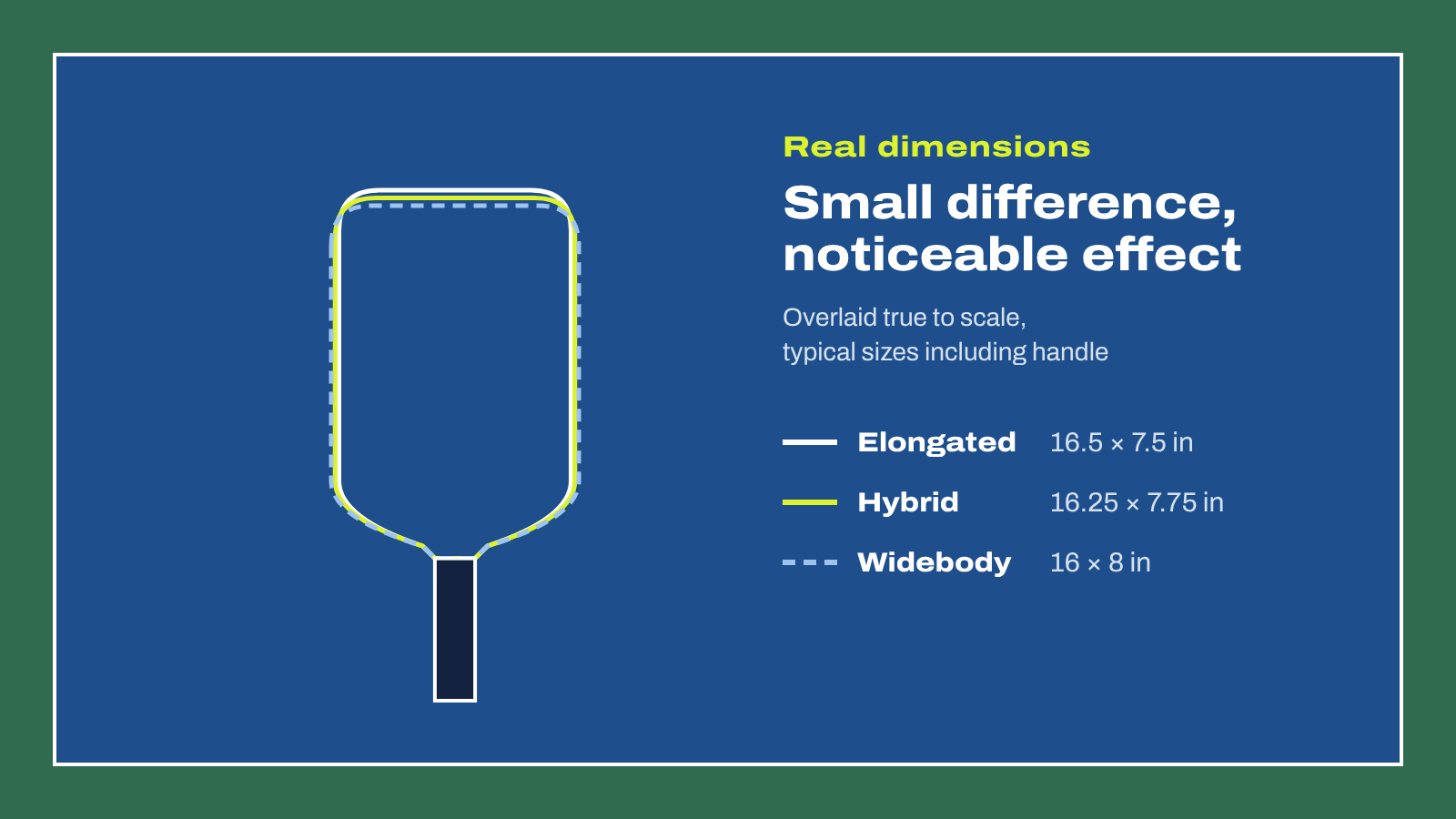
Some brands call the widebody shape "standard". There are also extra-long paddles of about 17 × 7 inches (43.2 × 17.8 cm), but they are rare.
Elongated: reach and power
Elongated paddles are longer and narrower.
Strengths: You reach more balls, and the longer lever puts more power into drives and serves. The sweet spot sits higher up on the face.
Weaknesses: The sweet spot is narrowest from side to side, and twist weight is lowest. An elongated paddle is therefore the least forgiving on off-centre hits. It also has the highest swing weight, so it feels slower in fast exchanges at the net.
Right for you if you play aggressively at an advanced level, play a lot of singles, or come from tennis and like to put weight behind the ball. An elongated paddle also suits players who tend to hit the ball towards the tip.
Widebody: control and forgiveness
Widebody paddles are shorter and wider.
Strengths: The sweet spot is the largest and sits in the centre. Twist weight is highest, so the face stays stable even on hits near the edge. The low swing weight makes the paddle manoeuvrable – ideal for quick hands on counters and for more control.
Weaknesses: Less reach and less power than hybrid and elongated paddles.
Right for you if you are just starting out, mainly want consistency, play a lot of doubles at the kitchen line or often hit the ball towards the sides.
Hybrid: the middle ground
Hybrid paddles sit between the other two shapes. Reach, sweet spot, swing weight and handling are balanced. The shape has no real weakness – but there is also no category in which it leads. The sweet spot sits higher than on a widebody and lower than on an elongated paddle.
Right for you if you don't want to commit, play both singles and doubles, need quick hands at the kitchen in doubles, or your misses are spread across the whole face. Among the active players analysed by Pickleball Effect, hybrid is now the most common shape.
The handle: important for two-handed backhands
Most paddles have a handle of about 5.5 inches (14 cm). Pickleball Effect recommends at least 5.4 inches (13.7 cm) for most players.
- Long handle (5.5 to 6 inches, 14 to 15 cm): room for a two-handed backhand and more leverage.
- Short handle: more length for the face, but two-handed shots become uncomfortable.
Important: handle and shape are two separate questions. There are widebody paddles with long handles too. If you play two-handed, check the handle length before you buy – whatever the shape.
Shape isn't everything
Shape points you in a direction, nothing more. Within one shape, paddles can differ considerably: there are widebody paddles with plenty of power and elongated paddles with plenty of control. So also compare the numbers within a shape:
- Swing weight and twist weight: what these two values mean is explained in our article Lead Tape on Your Paddle.
- Balance point: the lower it is, the more control and speed. The higher it is, the more power and the higher the sweet spot.
- Total weight: on its own it says little. Two paddles of the same weight can feel completely different.
And you can fine-tune: weight tape on the sides, for example, raises twist weight and makes an elongated paddle a little more forgiving.
Which shape is right for me? The quick check
- You mainly play doubles and spend a lot of time at the kitchen line → widebody or hybrid
- You are just starting out or mainly want consistency → widebody
- You come from tennis, play aggressively or play a lot of singles → elongated
- You hit a two-handed backhand → handle of at least 5.5 inches, whatever the shape
- You are unsure → hybrid
Pickleball Effect advises doubles players to at least try a hybrid or widebody paddle. In doubles especially, quick hands in exchanges at the net count for a lot.
Ideally, try before you buy: ask at your club or playing group whether you can test a different paddle for a few games. After three or four games, you usually know more than any table can tell you.
Key points
- Elongated: more reach and power, smaller sweet spot, less manoeuvrable.
- Widebody: largest sweet spot, most forgiving, fastest hands, less reach.
- Hybrid: the balanced middle ground and now the most common shape.
- Handle: at least 5.5 inches for a two-handed backhand.
- Shape isn't everything: swing weight, twist weight and balance point matter too.
Sources
- Pickleball Effect: The Definitive Guide for Choosing a Pickleball Paddle (dimensions, measurements and shares of the shapes).
- USA Pickleball, rule 2.E.3 (paddle size), summarised by PlayPickleball: Approved Pickleball Paddles, Balls and Apparel.
- Selkirk: Elongated vs. Widebody Pickleball Paddles.
- The Kitchen: Pickleball Paddle Shape Guide.
- Paddletek: How to Choose a Pickleball Paddle (handle and two-handed backhand).