Lead Tape on Your Paddle: Where Extra Weight Goes – and Why It Shouldn't Be Lead
A few grams in the right place noticeably change your paddle. Where weight does what, why the handle matters too and why you shouldn't use real lead anymore.
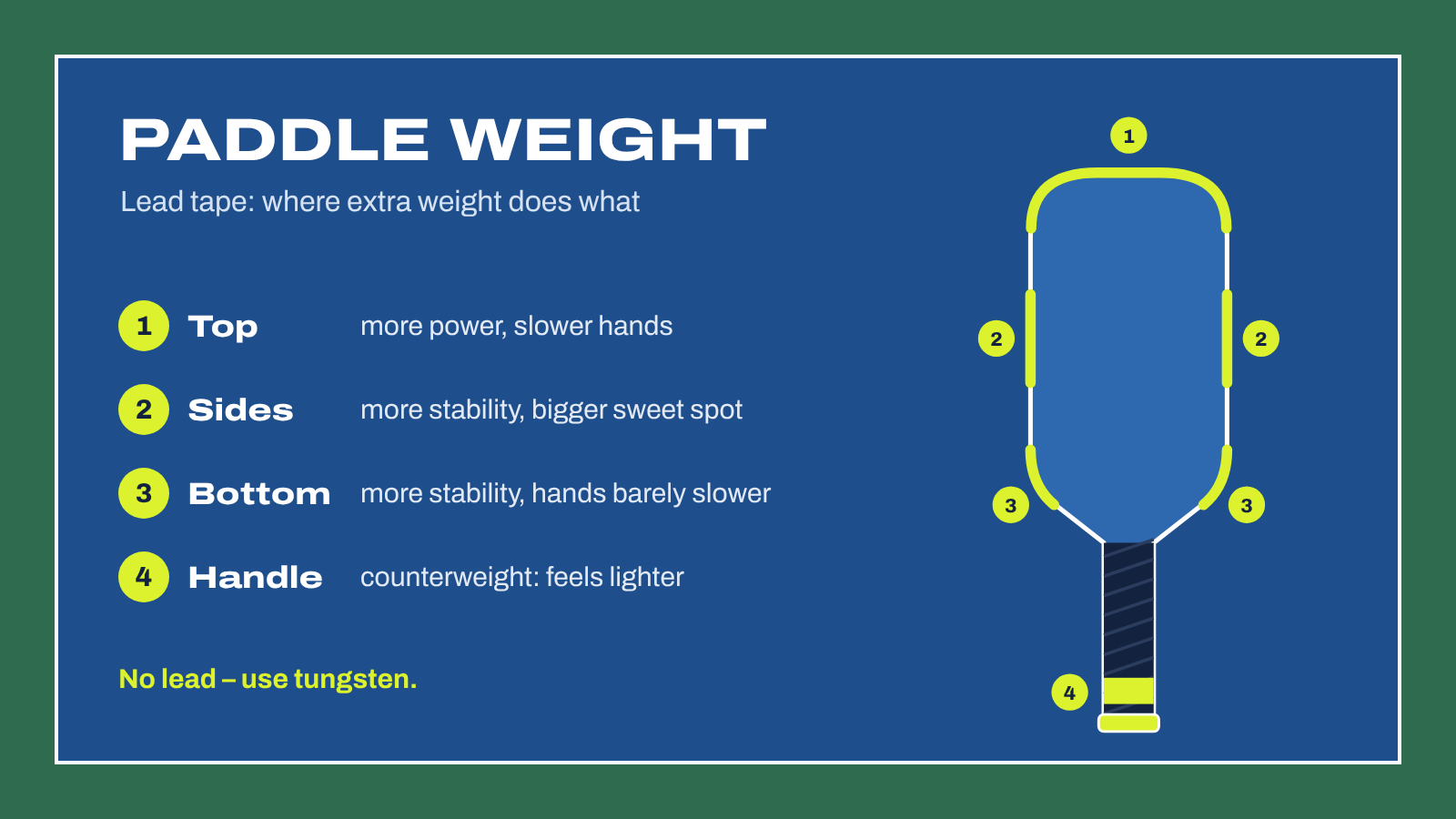
Many ambitious players stick weight tape on their paddle. The goal: more stability, a bigger sweet spot or more drive behind the ball. It is still called "lead tape" – the name has stuck, but the material should have changed. Here you will learn where extra weight does what, why weight in the handle can make sense and why you should no longer use real lead today.
Four terms you should know
- Total weight: What the paddle weighs on a scale.
- Swing weight: How heavy the paddle feels when you swing it. What matters is how far the weight is from your hand. A few grams at the top of the head have a much bigger effect than the same grams at the throat.
- Twist weight: How much the paddle twists in your hand on off-centre hits. The higher it is, the more stable the face stays – and the bigger the usable sweet spot.
- Balance point: The point at which the paddle balances. If it is higher up, the paddle is head-heavy; if it is lower, it is head-light.
Where weight does what
Think of the paddle face as a clock: the top is 12 o'clock, the sides are 3 and 9, and the throat is 6. That gives you four zones.
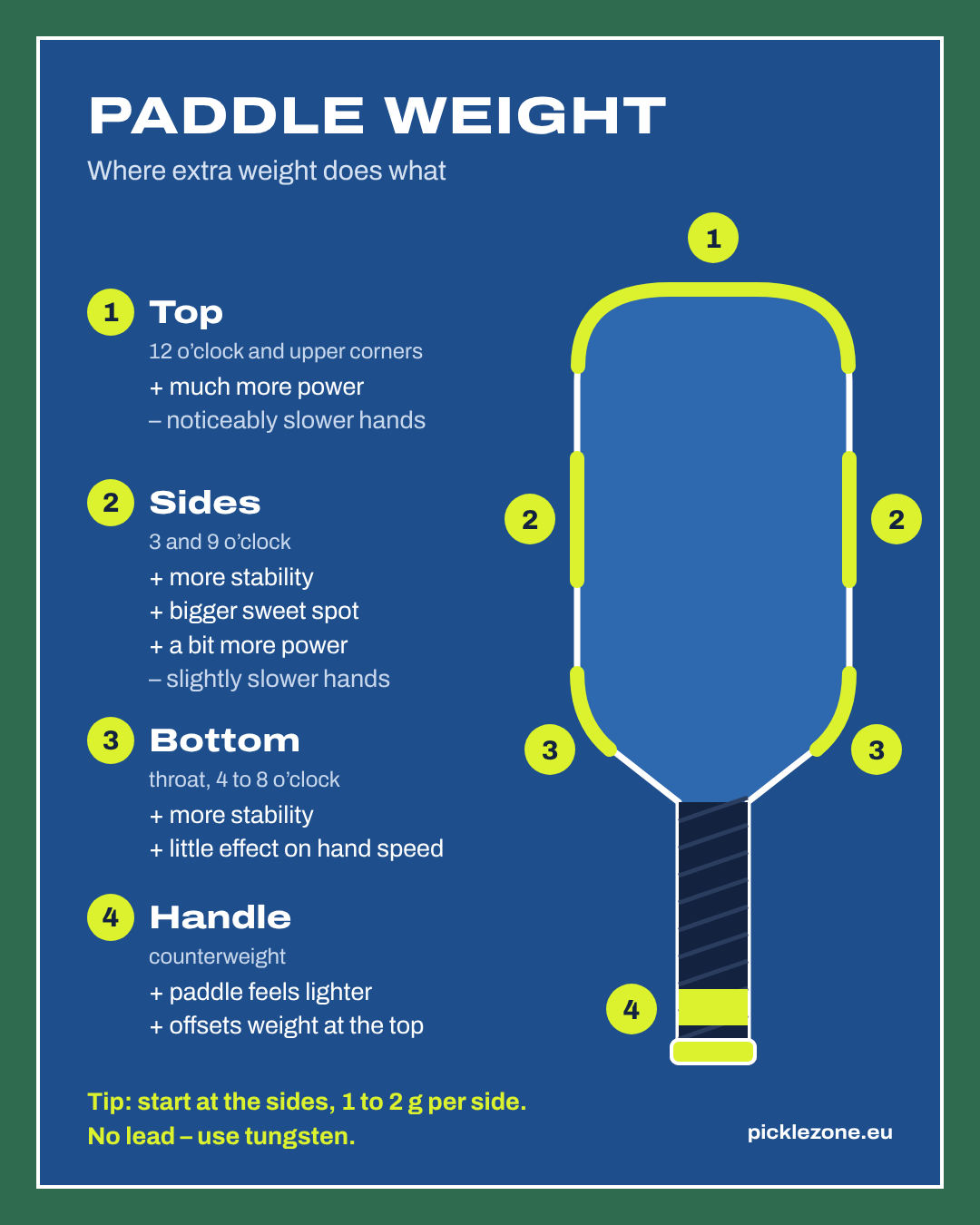
Graphic: PickleZone
| Zone | Effect | A good fit if … |
|---|---|---|
| 1 – Top (12 o'clock, upper corners) | much more swing weight, more punch on drives and overheads | you want more power – at the cost of speed at the net |
| 2 – Sides (3 and 9 o'clock) | more twist weight, bigger sweet spot, more stable blocks | your paddle twists on mishits – the best place to start |
| 3 – Bottom (throat, 4 to 8 o'clock) | more mass and stability, hardly any extra swing weight | you want a more solid feel without slower hands |
| 4 – Handle and butt cap | balance point moves towards the hand (counterweight) | your paddle feels too head-heavy |
The upper corners (2 and 10 o'clock) are a compromise between zones 1 and 2: a bit of power, a bit of stability.
Weight at the top puts more strain on your wrist and elbow. If you are prone to elbow problems, be especially careful there.
Weight under the grip: the counterweight effect
It sounds paradoxical, but it's true: you make the paddle heavier, yet it feels lighter. Weight in the handle – under the grip or at the butt cap – moves the balance point towards your hand. The paddle becomes less head-heavy and is quicker to move at the net.
The reason: how heavy a paddle feels depends mainly on how much weight sits far away from your hand. Weight in the handle sits exactly where you hold the paddle. It adds to the total weight but hardly to the swing weight – and it takes away the head-heaviness.
A counterweight is popular mainly as a complement. If you add weight to the sides for stability, a little weight in the handle offsets the extra head-heaviness. The paddle becomes more stable without feeling sluggish.
Why you should no longer use real lead
Lead is a toxic heavy metal, and according to current knowledge there is no safe level of intake. The body absorbs hardly any metallic lead through the skin. The problem is residue on your fingers that gets into your mouth when you eat, drink or touch your face. With a paddle that is particularly unfortunate: you hold it for hours, and with a counterweight in the handle your hand sits right on top of the weight. Children also like to pick up their parents' paddles.
There are good alternatives:
- Tungsten: Tungsten is considered much less of a concern and is even denser than lead, so you need less tape for the same weight. Tungsten tape made for pickleball mostly comes from the US so far. In Europe, you can get tungsten tape made for tennis, which works just as well on a paddle – for example at Tennis Warehouse Europe: the Tennis Warehouse Tungsten Tape (3 strips of 3 g) or the Wilson Tungsten Tuning Tape (4 strips of 2.5 g). Cover the tape with edge guard tape so it stays in place.
- Other lead-free weight strips: One source in Europe is the Gamma weight strips. According to the manufacturer, they are made of silicone with zinc powder and free of harmful substances. One inch weighs about 1 g, and the strips can be cut to size.
If your paddle still has old lead tape on it, replace it. Wear gloves when removing it and wash your hands thoroughly afterwards. The old tape does not belong in your household waste: lead is hazardous waste and must be disposed of properly. Seal the remains in a bag and take them to your local recycling centre or hazardous waste collection point.
How to do it
- Weigh your paddle: Write down the starting weight – a kitchen scale will do.
- Define your goal: What bothers you? If the paddle twists on mishits, use the sides. If you lack power, use 12 o'clock. If it feels too head-heavy, use the handle.
- Start small: about 1 to 2 g per side, always symmetrical.
- Clean the surface: degrease with a little alcohol, let it dry, then apply.
- Cover it: put edge guard tape or an overgrip over it so nothing comes loose.
- Test it: play at least one full session, then adjust in small steps.
What the rules say
Under USA Pickleball rules, weighted tape is explicitly allowed. There is no weight limit for paddles. For tournaments, the tape must lie flat and may only be placed along the edge, on the handle or on the butt cap – not in the middle of the hitting surface. The paddle must also still meet all specifications afterwards.
Videos on the topic
- Applying Weight to Your Pickleball Paddle? Watch This to See How Power & Control Are Affected – Pickleball Warehouse measures swing weight and twist weight for different positions.
- How & Where to Add Weight to Your Pickleball Paddle! – where each kind of weight belongs.
- Beginner's Guide: Why, How, and Where to Put Tungsten or Lead Tape on Your Pickleball Paddle – a step-by-step introduction.
- TUNGSTEN Is BETTER Than LEAD Tape! – why tungsten instead of lead.
Some videos still show real lead tape. The technique is the same – just replace the material.
Key points
- Sides (3 and 9 o'clock) add stability and a bigger sweet spot – the best place to start.
- Top (12 o'clock) adds power but costs speed at the net.
- Weight in the handle (counterweight) makes the paddle feel lighter and offsets weight at the top.
- No more real lead: use tungsten or other lead-free strips. Take old lead tape to a recycling centre or hazardous waste collection point.
- Start small, apply symmetrically, test.
Sources
- USA Pickleball: Rules Section 2 – Court and Equipment (paddle alterations, weighted tape) and summary of permitted alterations.
- Pickleball.com: Understanding Swing Weight and Twist Weight by Paddle Shape.
- Pickleball Warehouse: How to Customize Paddles.
- German Federal Institute for Risk Assessment (BfR): Evaluation of the BfR MEAL study on lead in food, 2025 (in German).
- Swiss Federal Office of Public Health: Lead fact sheet (in German).
- Gamma: Weight strips, 4-pack ½″ (manufacturer information).
- Tennis Warehouse Europe: How to customize your racket's weight and balance (counterweight in the handle).