What is DUPR? The pickleball rating explained
How DUPR works, why your rating can drop after a win and why the free account is all you need.
If you want to play a pickleball tournament, there is one number you can hardly avoid: your DUPR rating. It decides which division you enter, who you play with in open play and how you track your progress. At the same time, few things spark as much debate in the pickleball community. Here is how DUPR works, and why the system is smarter than many people think.
What is DUPR?
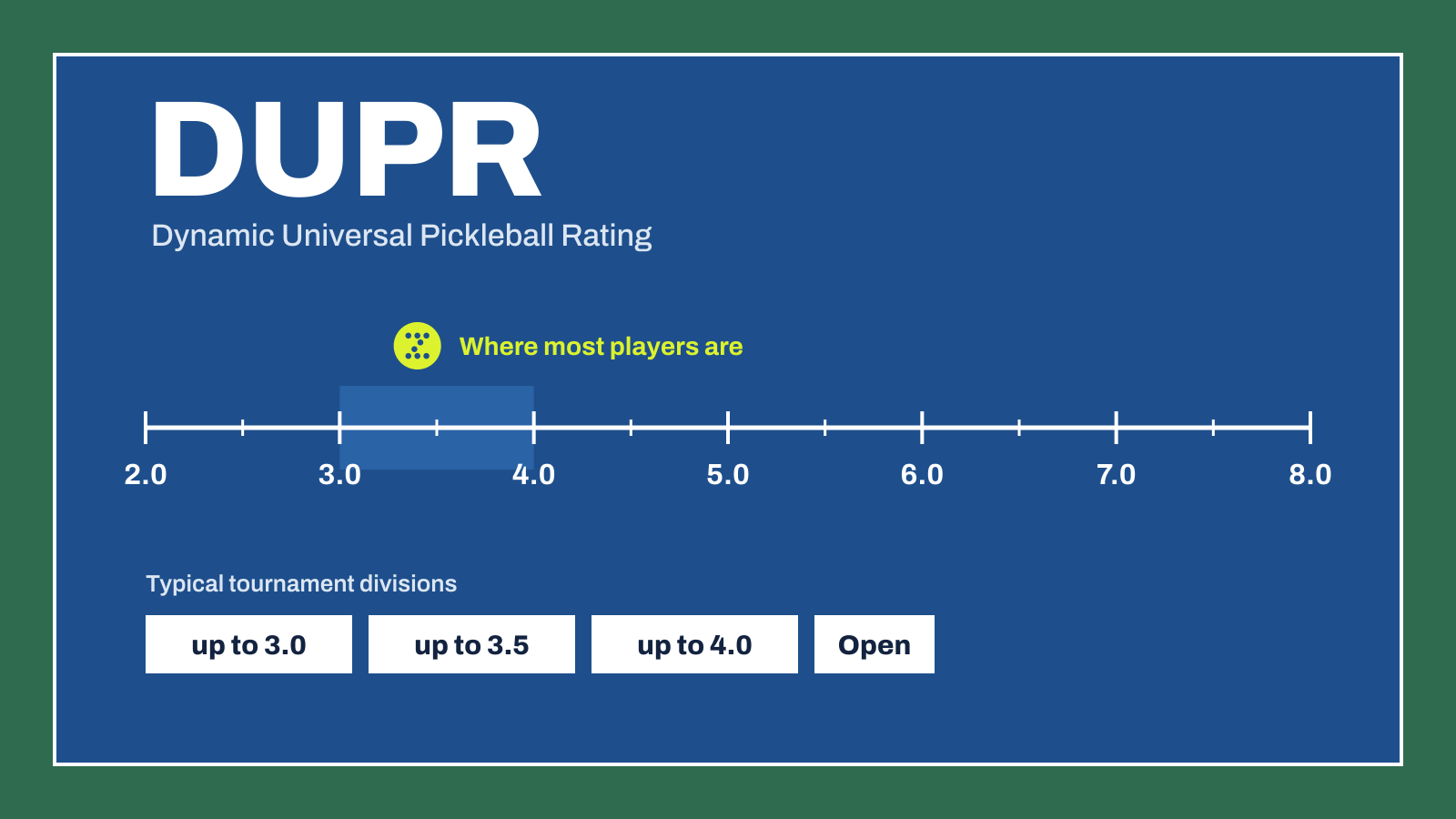
DUPR stands for Dynamic Universal Pickleball Rating. It is a rating system used worldwide that expresses your playing level as a number between 2.000 and 8.000. It was developed in the USA, and clubs, leagues and tournament organisers across Europe now use it too.
Good to know:
- There are two separate ratings: one for singles and one for doubles. They do not affect each other.
- Your rating comes purely from match results, not from self-assessment.
- In doubles, a team's strength is the average of both partners.
- Next to your rating, DUPR shows a reliability score from 1 to 100 percent. From around 60 percent, a rating is considered reliable. The fewer matches you have, the more each result moves your rating.
Free or DUPR+?
The DUPR app promotes its paid subscription DUPR+ very aggressively, some would say relentlessly. Don't let that unsettle you. For the vast majority of players, the free account is all you need. Your rating, your match results and the basic statistics remain free.
DUPR+ costs around 20 US dollars a year (as of October 2026) and adds extra analytics, regional rankings and a verified badge. There is one exception where it matters: "DUPR Verified" tournaments require an active DUPR+ subscription. So far these are mainly held in the USA. Simply check the tournament's entry information before you subscribe to anything.
Tournament divisions by DUPR
Most tournaments split their divisions by DUPR, for example:
- up to 3.0
- up to 3.5
- up to 4.0
- Open (no upper limit, where the strongest players compete)
This way, players of similar strength meet and everyone has a fair chance. The organiser decides exactly where the limits are drawn. In doubles, the team average often counts, sometimes the rating of the stronger partner. Always read the entry information. Many tournaments also offer age divisions, for example 50+.
Where are most players?
In autumn 2026, DUPR released figures on the distribution of all active doubles ratings. The picture is clear: more than half of all players are rated between 3.0 and 4.0, with the centre of gravity just below 3.5.
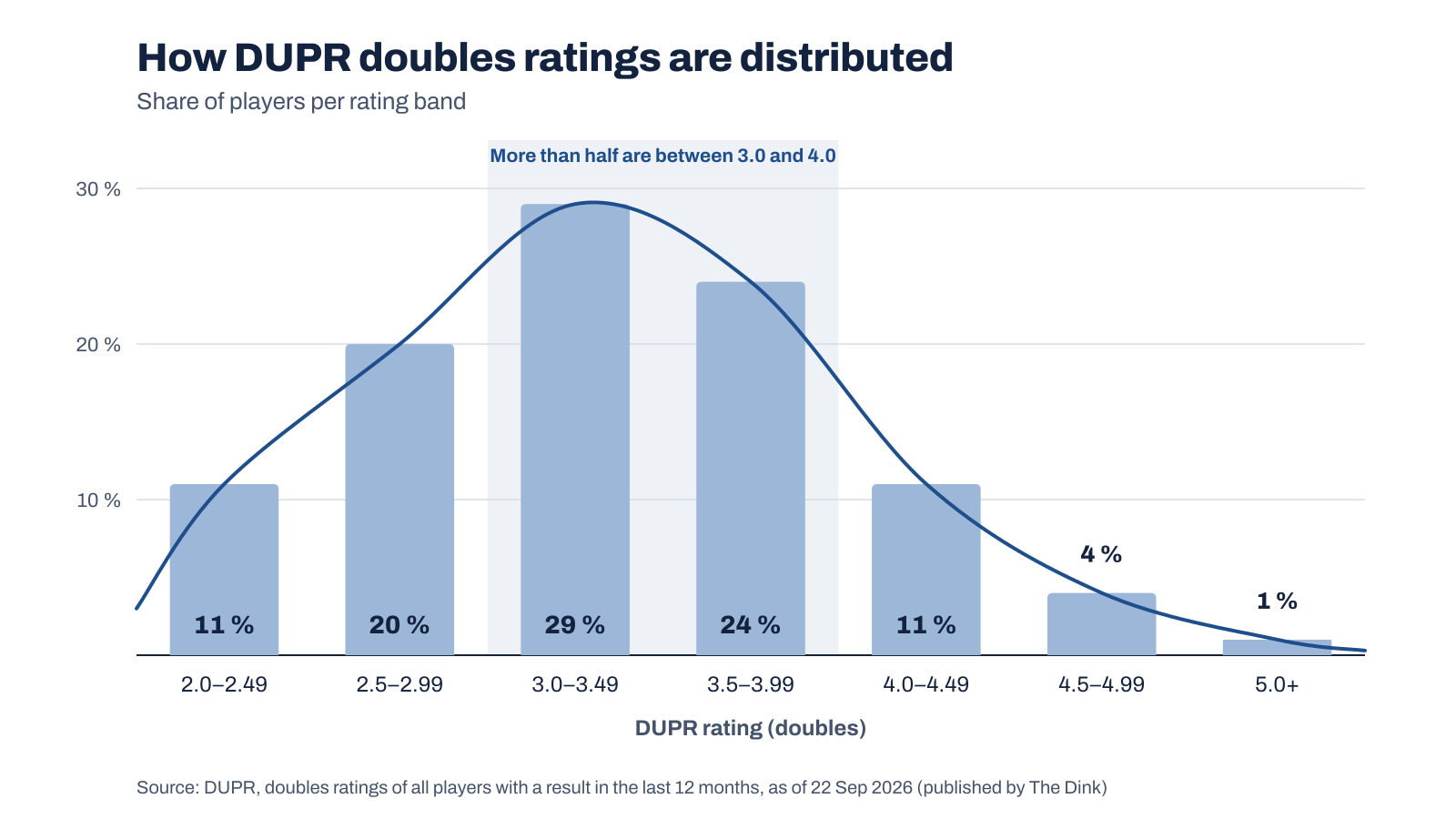
Source: DUPR, doubles ratings of all players with at least one result in the last 12 months, as of 22 September 2026, published by The Dink.
For context: with a rating of 3.5 you are better than around 60 percent of all active players. From 4.0 you are in the top 16 percent, from 5.0 in the top one percent. Tournament fields are a little stronger on average, because they attract the more ambitious players. So a 3.5 is not a "weak" rating. It is perfectly normal.
At the very top, the air gets thin: the absolute top pros have a doubles rating of around 7. At the end of October 2026, JW Johnson led the doubles ratings with 7.047, just ahead of Ben Johns with 7.032. So nobody comes close to the theoretical maximum of 8.0, not even the best players in the world.
How the algorithm works
DUPR is a further development of the Elo system known from chess. The key difference: DUPR doesn't just look at who wins, but at the exact score.
Simplified, it works like this:
- Before every match, DUPR calculates an expected score from the ratings of everyone involved.
- After the match, the actual score is compared with that expectation.
- If you do better than expected, your rating goes up. If you do worse, it goes down, regardless of who won.
An example from DUPR itself: if a 3.5 plays a 4.0 in singles, the system expects roughly 5–11. If the 3.5 loses only 9–11, they have beaten the expectation. Their rating rises even though they lost. The 4.0, on the other hand, drops slightly even though they won. According to DUPR, with a rating gap of around one full point the expected score is already about 11–2.
In addition:
- Tournament, league and club matches count more than self-reported recreational games.
- Recent results weigh more than older ones.
- The more reliable your rating already is, the less a single match moves it.
Why your rating can drop after a win
No part of DUPR causes more frustration: you win a match and your rating goes down. Many players feel this is unfair. Mathematically, though, it is unavoidable.
Imagine every win increased your rating. A 4.5 could play 3.0 players every week, win every time and keep climbing without getting any better. If more points were handed out than taken away after every match, all ratings would inflate over time. Today's 4.0 would be a 4.5 in two years without playing any better. The numbers would lose their meaning, and tournament divisions would stop working. DUPR gives exactly this reason: if nobody dropped after a match, the entire distribution would drift upward over time.
That's why the rating doesn't measure whether you win, but by how much compared with the expectation. If you only narrowly beat a much weaker team, you played below your level, and that is exactly what the rating shows.
The comparison with the golf handicap
Golfers have known this principle for a long time. Under the World Handicap System, your handicap is based on the best 8 of your last 20 rounds. You can win a tournament because everyone else played even worse that day. But if your round isn't among your best eight, and a good older score drops out of the window, your handicap still gets worse. Winning a tournament and your handicap simply measure different things: one is how you compared with the field that day, the other is your actual level.
A rating is not a ranking
This is the most common misunderstanding. DUPR is a rating, not a ranking:
- A ranking is a leaderboard. Whoever plays and wins many tournaments collects points and climbs. It rewards success and effort.
- A rating is a measurement. It estimates as accurately as possible how well you play today, so that matches are predictable and fair.
A rating is therefore not a reward you "earn", and not a punishment when it drops. It is an honest snapshot.
What is a sandbagger?
A sandbagger is a player who deliberately keeps their rating low to enter a weaker division and win easily. The term is also familiar from golf, where it describes players with a deliberately inflated handicap.
Typical tactics are not reporting results, deliberately keeping games close or only entering divisions far below their real level. For everyone else this is frustrating: if you play a hidden 4.0 in the up-to-3.5 division, you don't stand a chance. Since July 2025, a win alone no longer earns rating points on DUPR; what counts is performance against the expectation. That makes sandbagging much harder: anyone who deliberately keeps games close or loses has to do so in every single match.
Why an honest rating is in your own interest
It's understandable to be attached to "your" number. In the end, though, it is in everyone's own interest to be rated at their true, current level and to enter tournaments in the right division:
- Exciting matches: Pickleball is most fun against opponents of equal strength.
- Real progress: You learn more against equals than from easy wins or heavy defeats.
- Fair tournaments: If everyone plays honestly, divisions work for everyone.
- A win that means something: A title in the right division is worth more than one gained through an artificially low rating.
Frequently asked questions
How do I get a DUPR rating?
Download the free DUPR app, create an account and record your matches, or play at clubs, leagues and tournaments that report results to DUPR. After a few matches you'll have a first rating. Each further match makes it more reliable.
Do I need DUPR+ to play tournaments?
Usually not. Only "DUPR Verified" tournaments require DUPR+. The entry information will tell you.
Why did my rating drop after a win?
Because you won by less than the system expected against weaker opponents. That's not a bug. It keeps ratings stable and comparable.
Do singles and doubles count together?
No. DUPR keeps separate ratings for singles and doubles.