Pickleball Instead of Padel: Why Investors Should Bet on the Next Market Now
Anyone looking to invest in racket sports in Europe today shouldn't ask which sport was successful yesterday – but which one offers the greatest leverage tomorrow. A lot points to pickleball.
Anyone looking to invest in Europe today shouldn't ask which sport was successful yesterday, but which one offers the greatest leverage tomorrow. That is exactly why a lot currently points to pickleball.
1. Europe is only at the very beginning with pickleball
Padel has already seen a significant boom in Europe. According to the world federation FIP, around 61 percent of all padel players worldwide are in Europe. Spain has more than 17,000 padel courts, Italy more than 10,000. Germany is catching up fast, too: in early 2026, the German Padel Association reported around 300 locations with about 1,200 courts and expected almost 2,000 courts by the end of the year. Large chains are expanding with millions in funding: Munich-based PadelCity, for example, aims to grow to around 40 locations with 350 courts by the end of 2026 and is already expanding into Austria and Poland. Many operators are now competing for the same target group.
Pickleball, on the other hand, is still in an early growth phase in Europe – with considerably greater development potential. Documented player numbers are small: a global pickleball report counts around 60,000 players for England and Spain combined. Most play takes place in clubs and sports halls; there are only a few dedicated pickleball facilities so far. Investing now means not entering a saturated market, but actively shaping it.
2. The economics favour pickleball
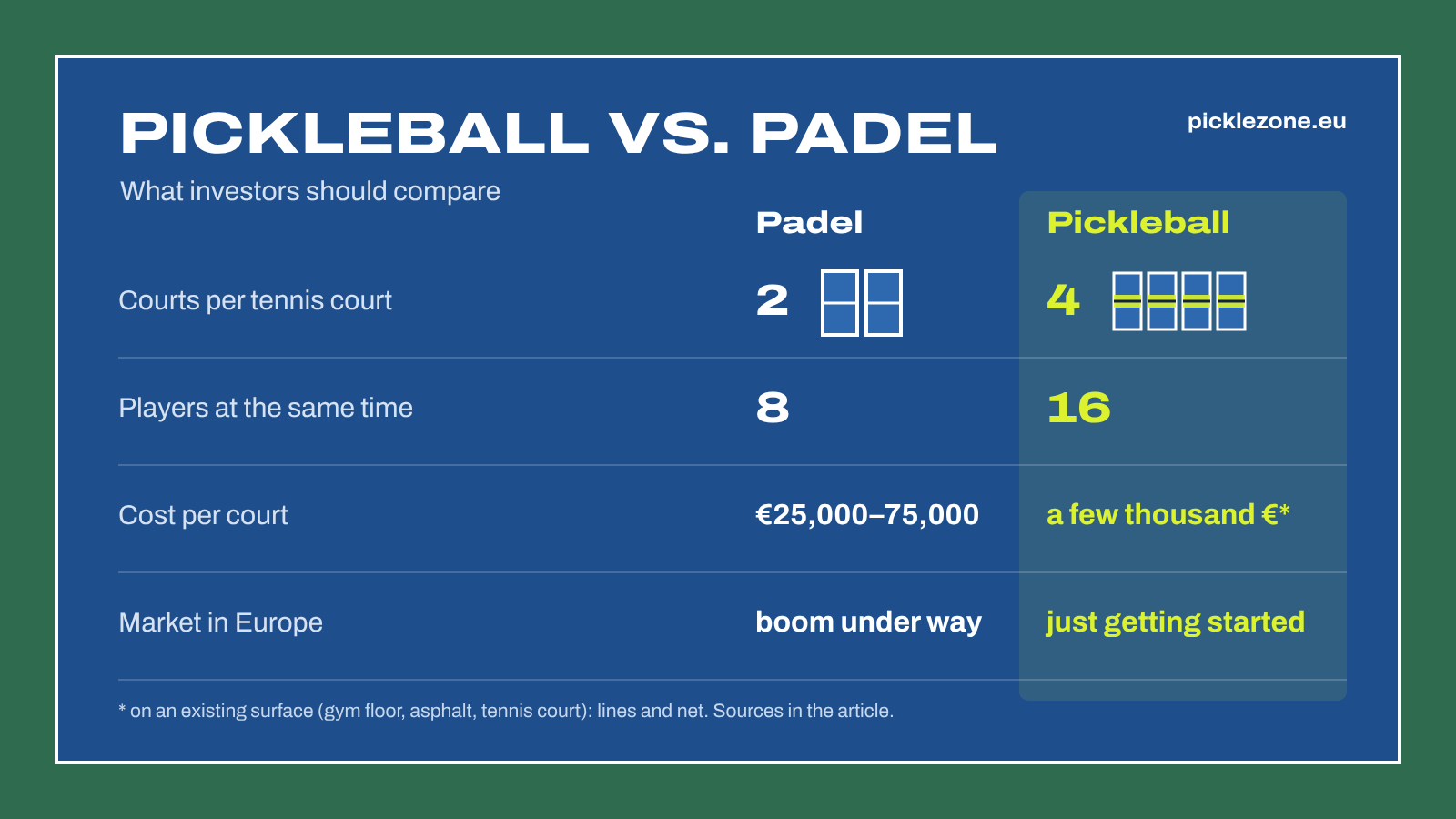
A pickleball court usually costs only a fraction of a padel court. Depending on the design, a padel court with glass walls, steel structure and artificial turf costs from around €25,000 (indoors on an existing concrete slab) to about €75,000 (outdoors including foundations). Pickleball needs neither glass nor steel: on existing asphalt, a tennis court or in a hall, a court with lines and a net can often be set up for a few hundred to a few thousand euros.
Then there is space efficiency: one tennis court fits four pickleball courts but usually only two padel courts. On the same area, 16 instead of 8 people play at the same time. That increases potential utilisation and significantly reduces investment risk. And because no fixed walls are needed, spaces can be used flexibly – from multi-use courts to converted commercial halls.
To be fair: anyone building a pickleball court completely from scratch, with sub-base, surface and fencing, is also looking at five figures. The big cost advantage comes where existing spaces can be used.
3. Pickleball is the more social sport
The biggest success factor isn't the paddle – it's the community. Worldwide, "open play" is standard: players of different levels come together, switch partners and opponents after every match and get to know new people in no time. In padel, by contrast, the booked match for four is the norm: you reserve a court and split the court fee four ways. A low-threshold, open format like open play is much less common there.
For operators, that is a real advantage: anyone who comes alone immediately finds partners at open play. That lowers the barrier for new customers and binds them to the facility.
4. Almost anyone can get started
In our experience, beginners are already playing longer rallies and having fun after 15 to 30 minutes. This low barrier to entry is one of the main reasons for the rapid growth. At the same time, the top level remains extremely demanding, technically and tactically – easy to learn, hard to master. That appeals to a broad target group: from beginners and former tennis players to tournament players, young and old.
5. The global trend is clear
According to the industry association SFIA, around 24 million people in the US now play pickleball (2025); other surveys even cite more than 36 million. That is more than five times as many as in 2020. So in the US alone, more people play pickleball than the current Global Padel Report by Playtomic and PwC counts padel players worldwide: around 19 million. The world federation FIP, however, puts padel at more than 35 million – the figures are based on different counting methods.
For pickleball worldwide, there are estimates of 80 to 120 million players. They depend heavily on figures from China and should be treated with caution. What is clear, though: worldwide, pickleball plays in the same league as padel or above.
At the same time, pickleball in Europe is still far from this level of market penetration. That is exactly where the opportunity lies: the sport is already proven globally, but the home market is only just beginning.
What investors should still consider
No market is a sure thing. Three points belong in every calculation:
- The hall is the real cost factor. In much of Europe, year-round operation requires a hall. The court itself is cheap; renting or building the property is not.
- Willingness to pay has yet to be proven. Padel facilities in Europe already demonstrate working pricing models. For pickleball, it remains to be seen which prices and utilisation levels can be achieved here.
- Growth isn't linear. In the US, too, the expansion of public courts in the big cities has recently slowed: up 4 percent from 2025 to 2026, after 13 percent the year before.
The key message
Padel is better known in Europe today. Pickleball has the greater growth potential.
Investing in a trend that has already peaked means participating in the existing market. Investing in a trend that is already proven worldwide but only just beginning in Europe means participating in growth.
Or, put a little more provocatively:
Padel is what Europe is talking about today. Pickleball is what Europe will be talking about in five years. Anyone who wants to invest shouldn't chase today's hype, but build the next market.
From an investor's point of view, this is probably the strongest argument: lower investment costs, greater space efficiency, lower barriers to entry, stronger community loyalty and a growth trend that has already been validated globally.
This article reflects the author's assessment and is not investment advice.
Sources
- SGI Europe: Padel is in constant growth around the world, says latest FIP report, 2025, and industry report April 2026 (61 percent of padel players in Europe).
- Statista: Countries with the most padel players (courts in Spain, in German).
- FIP: Italy surpasses 10,000 courts, second only to Spain, June 2025.
- German Padel Association: Statement for the German Bundestag, March 2026 (locations and courts in Germany, in German).
- startbase: Compagnie des Alpes acquires 33.9 percent of PadelCity (in German).
- InvestmentWeek: Padel millions: why the new racket sport has suddenly become a tough business, 2026 (padel court construction costs, in German).
- ThePricer: Cost to Build a Pickleball Court (lines, nets, conversion, new build).
- Selkirk: How to Play Pickleball on a Tennis Court (four pickleball courts per tennis court).
- Padel Market: Padel Court Dimensions (two padel courts per tennis court).
- Statista: Number of padel courts in Germany (court fee split four ways, in German).
- Pickleball.com: SFIA Report Confirms Over 24 Million Americans Playing Pickleball, 2026.
- OMR: Can padel become Europe's new trend sport? (36.5 million pickleball players in the US, in German).
- PADEL1969: Global Padel Report 2026 – analysis (19.4 million players according to Playtomic, 35 million according to FIP).
- Pickleball.com: Global Pickleball Reach Hits Estimated 80–120 Million Players.
- Axios: Pickleball court building slows, 26 May 2026.