Indoor or Outdoor Ball? Why They Should Really Be Called Soft-Court and Hard-Court Balls
The packaging says "indoor" or "outdoor". What really matters is not whether you play inside, but what surface you play on. How the balls differ and when to use which.
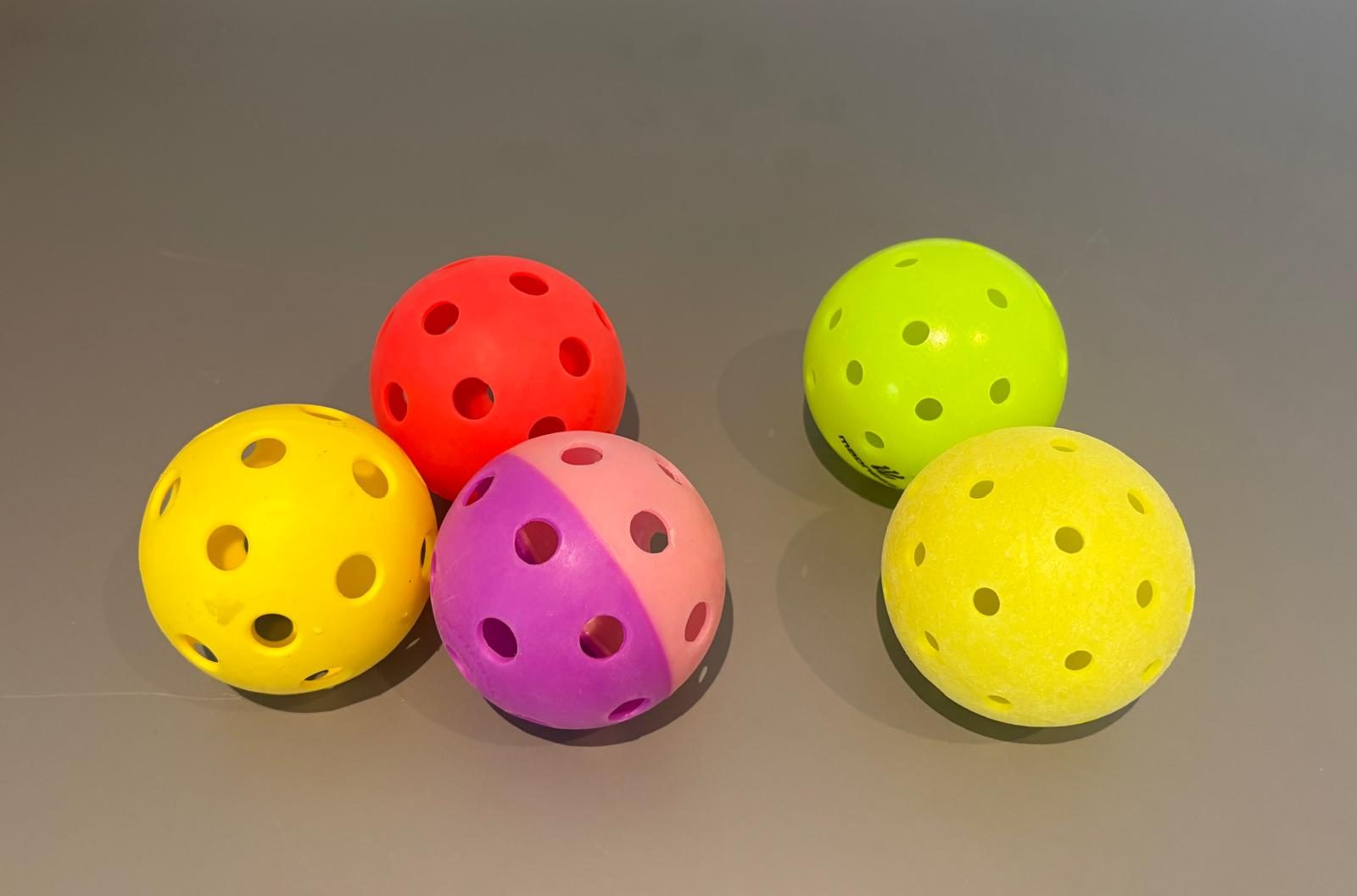
Anyone buying pickleballs faces a choice straight away: indoor or outdoor? The names sound obvious – one ball for inside, the other for outside. But that is exactly what misleads many players. What matters is not whether there is a roof over the court, but what surface you are playing on. That is why the two types should really be called soft-court balls and hard-court balls today.
What the rules say
Both types must meet the same specifications. According to the USA Pickleball Equipment Standards Manual, a ball must
- measure 2.87 to 2.97 inches (7.29 to 7.54 cm) in diameter,
- weigh 0.78 to 0.935 ounces (22.1 to 26.5 g),
- have 26 to 40 circular holes, and
- bounce 30 to 34 inches (76.2 to 86.4 cm) when dropped from 78 inches (198 cm).
Within these limits, however, the two types differ clearly.
The differences at a glance
| Indoor / soft-court ball | Outdoor / hard-court ball | |
|---|---|---|
| Holes | usually 26, larger (about 11 mm) | usually 40, smaller (about 7 mm) |
| Plastic | softer, thinner wall | harder, thicker wall |
| Weight | towards the lower end | towards the upper end |
| Flight | slower, more drag | faster, more stable in wind |
| Feel and sound | soft, rather dull | hard, a bright "click" |
| Well-known models | Franklin X-26, Gamma Photon Indoor, Head Championship 26 | Franklin X-40, Gamma Chuck Outdoor (38 holes) |
Why "indoor" and "outdoor" are misleading
The names date from a time when indoor play almost always meant a sports hall, and outdoor play meant asphalt or concrete. "Indoor" meant a gym floor. "Outdoor" meant a hard surface.
In the US, that equation stopped holding long ago. Many indoor venues there have courts built specifically for pickleball, with a hard, coated surface. These are essentially outdoor courts with a roof. According to the US site Pickleball.com, most American "indoor" courts are exactly that. They call for an outdoor ball, even though you are playing inside.
US pros do the same: in 2023, the "indoor" tournaments of the PPA and APP tours and of USA Pickleball were not played on true gym floors but on hard courts under a roof – with outdoor balls such as the Onix Dura Fast 40 and the Franklin X-40. Even ball maker Onix says the surface, not the location, should decide which ball you choose.
Europe is a different story – for now. Here, a lot of indoor play still takes place in sports halls, and infrastructure like in the US is only slowly emerging. If you play indoors in Europe, you will usually be on a real gym floor. But with every new pickleball hall, it becomes more important to look at the floor rather than the roof.
Soft-court ball: made for gym floors
The classic indoor ball is designed for gymnasium floors, the kind you know from schools and clubs. These floors – hardwood, linoleum or synthetic – are smooth and give slightly under load to protect the joints.
A hard ball finds little grip on such a floor. It comes off lively and is harder to control. The softer soft-court ball with its large holes flies more slowly, is easier to control and leads to longer rallies. The extra drag does not matter indoors, because there is no wind.
A typical example is the multi-purpose sports hall, where the pickleball lines sit between the badminton and volleyball markings. That is classic soft-court territory – and currently the most common place for indoor pickleball in Europe.
Hard-court ball: made for hard surfaces
The outdoor ball is built for hard surfaces: asphalt and concrete as found on multi-sport courts, and above all dedicated pickleball courts with an acrylic coating. Whether such a court is in the open air or inside a hall makes no difference.
The rough surface would quickly wear down a soft ball. The harder plastic with its thicker wall can take it. The many small holes also make the ball stable in wind. That matters outdoors and does no harm under a roof.
Which ball is right for you?
Don't look up – look down:
- Smooth gym floor (hardwood, linoleum, synthetic): soft-court ball, i.e. an "indoor" ball.
- Hard court (asphalt, concrete, acrylic-coated pickleball court), inside or outside: hard-court ball, i.e. an "outdoor" ball.
- Not sure? Ask the venue which ball is used there. For tournaments, the official ball is usually listed in the announcement.
A hard-court ball on a gym floor works if you have nothing else, but it feels hard and fast and bounces less on drives. A soft-court ball outdoors, on the other hand, is a really bad idea: it wears quickly on rough surfaces, bounces unpredictably and gets pushed around by the wind.
Tip for the cold season
Hard-court balls are made of hard plastic. Below about 10 °C (50 °F) it becomes brittle, and the balls crack much more quickly. So don't leave your balls in a cold car – bring them to the court at room temperature. A spare ball in your jacket pocket stays warm.
Key points
- Both ball types meet the same rules, but differ in holes, material and flight.
- The floor decides, not the roof. On dedicated pickleball courts, you play with the outdoor ball even indoors.
- In Europe, most indoor play still happens in sports halls. That is where the indoor ball belongs.
- Soft-court ball and hard-court ball would be the more accurate names.
Sources
- USA Pickleball: Equipment Standards Manual (specifications for size, weight, holes and bounce).
- Will Daughton: Why is there no universal ball for pickleball? Pickleball.com, 4 January 2024.
- Onix: Indoor vs. Outdoor Pickleballs: It's Not About Where You Play.
- Paddletek: Indoor vs. Outdoor Pickleballs (average hole sizes).
- Pickleball.com: Why Do Pickleball Balls Crack?